It is concerning that diffusion-based AI technologies have the potential for imaging that which does not exist, emulating historical aesthetics and creating “imagined realities” of historical events. This technique of manufacturing composites from the metadata of a few billion images produces what researcher and artist Hito Steyerl calls a “mean image,” a play on words referring to both a statistically average image representative of the “data populism” of the internet, as well as suggesting the common, exploitative, or even crass manner in which these images are constructed.
Researcher Eryk Salvaggio further asserts that AI images are therefore a kind of comparative analysis tool; they are “infographics for their datasets,” and reveal biases about how the internet “sees” and understands certain topics.
In 2023, I co-wrote a peer-reviewed journal article with scholar of religion Diana Walsh Pasulka, exploring the use of AI image generators to produce religious imagery and the ethics of doing so. In the course of our writing, I became aware of the history of artworks that altered eyewitness testimony of religious events for theological or aesthetic purposes as educational tools for an illiterate populace, primarily within the mystical visions of St. Francis of Assisi. I found this correlated to how programs like Midjourney and Dall.E are deliberately tweaked to favor broadly commercial and visually appealing imagery within their training set, a process called “aesthetic weighting.”
A presentation of our paper given to the American Academy of Religion, June 27th, 2024.
My work with Pasulka challenged me to assess how I visualize the sacred and work with archives of religious art history. Simply by working in this space, my creative and research endeavors are now a part of the material culture of the Catholic sacred tradition. My work has the potential to build upon the tradition and influence derivative works. One such example of this was a response article to our research paper that used our methodology to create and analyze AI-generated images of the Fatima Marian apparition, a body of work I began while writing the paper and which found its way into the Felt Presence exhibition.
Fatima, Portugal – October 13, 1917
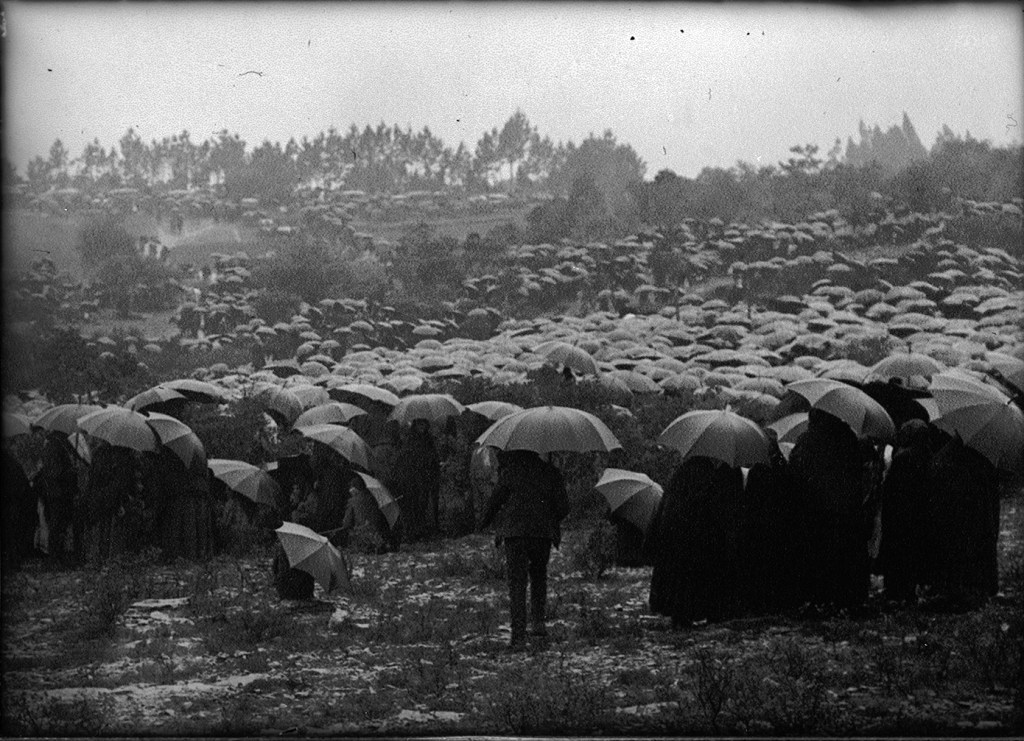
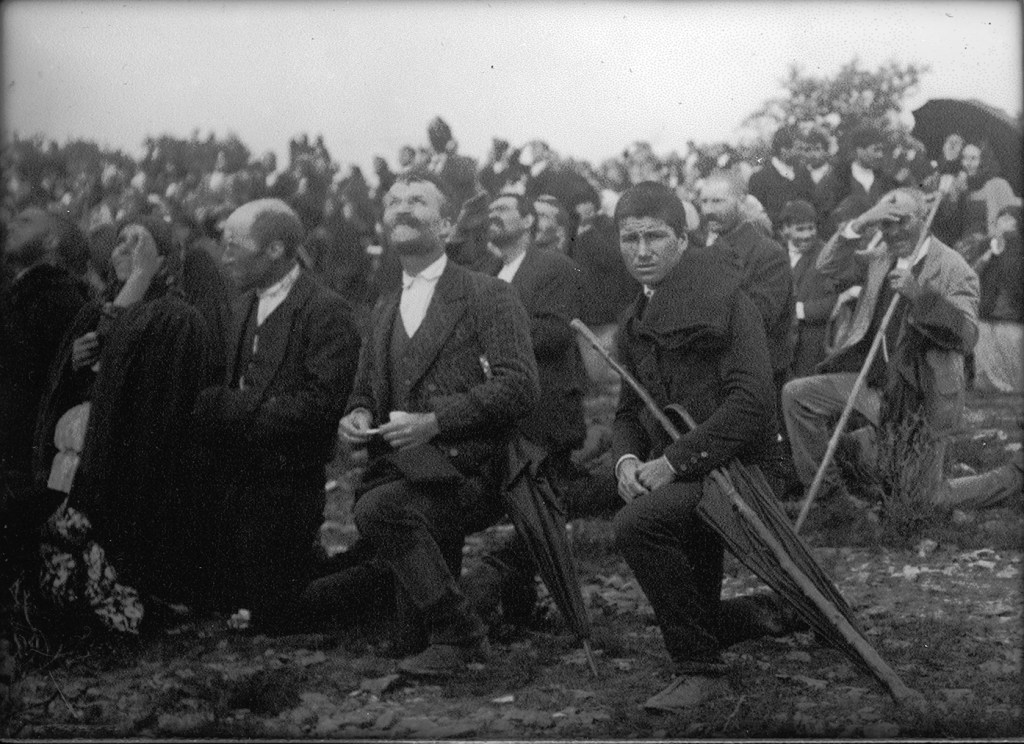
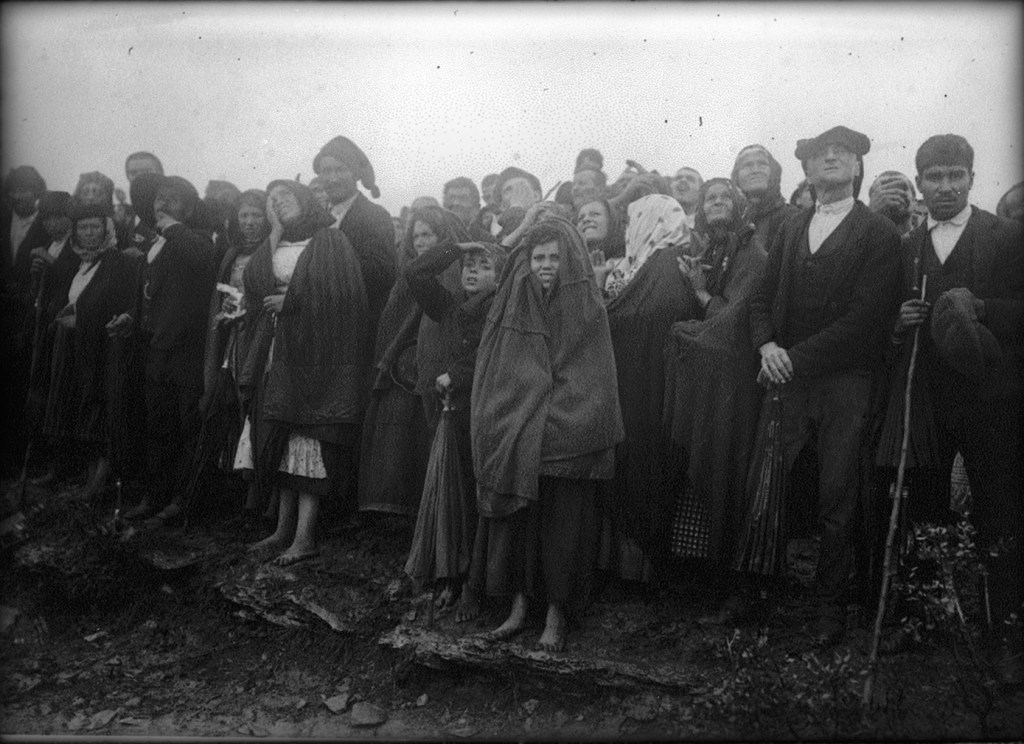
Judah Bento Ruah is on assignment from the weekly secular journal Illustração Portuguesa, traveling with reporter Avelino de Almeida. They have been told that the Virgin Mary has been appearing to three illiterate peasant children, Lucia Dos Santos, and her cousins Jacinta and Francisco Marto each 13th of the month for the last six months. The children have said that a great miracle will take place on this day, the last prophesied appearance of the Blessed Virgin Mary. A crowd of upwards of 70,000 people are in attendance. They watch the skies and wait. Shooting on 9x12cm glass plate negatives, Ruah lugs his heavy press camera and tripod through thick mud, documenting the spectacle:
“Suddenly, the sun pulled apart the clouds and showed itself in a dizzy, rotating movement, only to later descend impetuously, giving the impression that it would come loose from the firmament and kill us all.”
Mother Maria Do Carmo de Fonseca
Swipe or click right to view the slideshow.
“Before or after seeing the globe, but certainly on the same day, myself and some others… began to see something fall, as if the petals of roses or flowers of snow were coming from the heights and disappearing just a little over our heads, with us being unable to touch them.”
Father Jose Galamba de Oliveira
Given the amount of witness testimony from credible sources, including lawyers, doctors, and journalists, photography from the event invites a skeptical eye because of biases we apply to the medium, including those of “an objective camera” and the ethics surrounding a “photojournalistic lens.” How is it that thousands of people can testify to a miraculous occurrence, but no photo can exist which reveals incontrovertible proof?
This is the same dilemma we can apply to any claim of the miraculous and is the deep tension that this exhibition seeks to hold the viewer within. To a skeptic, there will always be explanations for why a miraculous claim may not be justified. Yet, despite an increasingly secular society, miraculous events continue to happen in the modern day, astounding the experiencers and producing measurable effects on believers, such as changes in lifestyles and behaviors.1
As it turns out, a photograph’s “objective presentation of reality” may not matter. The weekly journal the images were first presented in, Illustração Portuguesa, was only made possible by the advent of new technologies at the turn of the century, namely easy-to-use, portable Kodak cameras and photoengraving, a method of industrial photo printing for newspapers. Considering that Portugal had an illiteracy rate of almost 70% in 1917, Ruah’s photographs were informed by the journal’s editorial ethos, constructing a narrative through sequential images meant to be seen first, and then read afterwards.
Illustração Portuguesa, October 29th, 1917. Public domain.
As Fatima researcher Paulo Catrica explains:
“Ruah’s photographs are today inseparable from the historiography of the Apparitions of Fatima… As the only known photographs of the Miracle of the Sun, the founding moment of the Fatima cult, the historical importance of the events inscribed in the photographs offer a multiplicity of symbolic meanings. Their public relevance has changed in response to numerous contexts and reasons in the history of Fatima.”[2]
Despite having no photographic proof of the actual “Miracle of the Sun” and miraculous rose petal fall, we do have extensive and credible witness testimony, contributing to my personal belief that the events of October 13th, 1917 did happen. This reflects my biases as a person of faith and spiritual seeker, but I am also using my scientific skepticism and due diligence to reconcile the archive of these events that offer legitimacy towards their having happened.
“It was similar to a disk with a distinct and lively border, luminous and lucent, having the opalescence of a pearl. It was not spherical, like the moon. It seemed like a polished wedge, cut from the nacre of a conch shell. One could gaze at the star, flame of light and hot coal of heat, without any pain in one’s eyes and without any dazzle in the retina.”
Jose MariA de Proenca de Almeida Garrett, Lawyer
I determined that it would be an interesting experiment to use the existing archival imagery provided by Judah Bento Ruah as a training set to produce “imagined realities” of these events, rendering photorealistic, period-appropriate images of the Miracle of the Sun and rose petal shower. These images would then be presented alongside Judah Bento Ruah’s photographs of the day. The further question would then be: what is my responsibility in informing my audience that some of these images are AI-generated?
The weight of this responsibility was not lost on me. Despite being Catholic, I intend for my exhibition to be for all audiences. I feel that I have a responsibility to educate and inform, but the use of AI imagery in this work comes with an ethical burden; namely, do I reveal the “magician’s trick” or do I make the audience work to discover the illusion themselves?
Mirroring Catrica’s analysis that the Fatima images represent a “multiplicity of symbolic meanings… changed in response to numerous contexts,” I determined that these images presented in my installation would challenge my audience’s ability to discern, and therefore, would provide an invaluable tool they will need to navigate our landscape of post-AI images.
Discernment is a sacred Catholic practice. While discernment is most often applied to the spiritual practice of determining one’s vocation, or role, in life, it is also a tool used to navigate an uncertain and difficult world. By implementing both faith and reason, the use of our God-given faculties to navigate the world, we can arrive at conclusions that inform and enrich us.
In order to do this, I’ve deliberately constructed the presentation of the Fatima images in my exhibition. The viewer enters the gallery with a statement that reads, “I have no intention of misleading or deceiving you. These things happened.” They are already primed to question if what they are experiencing is true. Upon being confronted with backlit glass plate negatives and positive prints framed to appear in museum curatorial fashion, they must question the images’ relationship to one another. The aesthetics of credibility on display suggest that these are originals and that one is produced from the other. A wall text states that they are the product of Judah Bento Ruah, a photojournalist on assignment from a Portuguese newspaper.
Witness testimony is displayed on wall text alongside the images, contextualizing what we see and assisting in the development of a chronological narrative. For those viewers who are unfamiliar with the Fatima event, they will be challenged into thinking that this is all a made-up narrative, and yet, the images appear photo real. Any internet research will produce some of the images seen in the gallery alongside the voluminous histories written about the event. How does one then make sense of those images that intellectual reasoning tells them must be impossible, such as the rose petal shower and the sun “dancing in the sky?”
Viewers must lean into their discernment to determine what is real and what is fake, and why someone might seek to engineer their beliefs in such a way. My hope is that the viewer’s experience with this gallery will get them to think critically about their engagement with all images in our current media landscape. Who are the people behind the images who seek to capture and control their attention? How are the images being used to affect their beliefs? I make no claims beyond these for how I want the viewer to interpret the gallery. The journey beyond that point is theirs to discover.






 Mark J. Burchick